
Want to tell me what challenges you're facing?
Here's what I can do for you, and how we'd start.
Here's what I can do for you, and how we'd start.
If a process depends on someone remembering every step, I'd start there. My own AI work kept forgetting what the last chat knew, so I thought: what if the repeated steps ran on their own, and a person or an AI only stepped in where something had to be decided? So that's how I map the work now, and then I build the tools and instructions around it.
What that can include
You get work that no longer depends on one person's memory.
How it runs
Proof
I run my own work this way. Maru gives each new AI chat the same context, rules and permissions before it touches anything, and I use it every day.
See Maru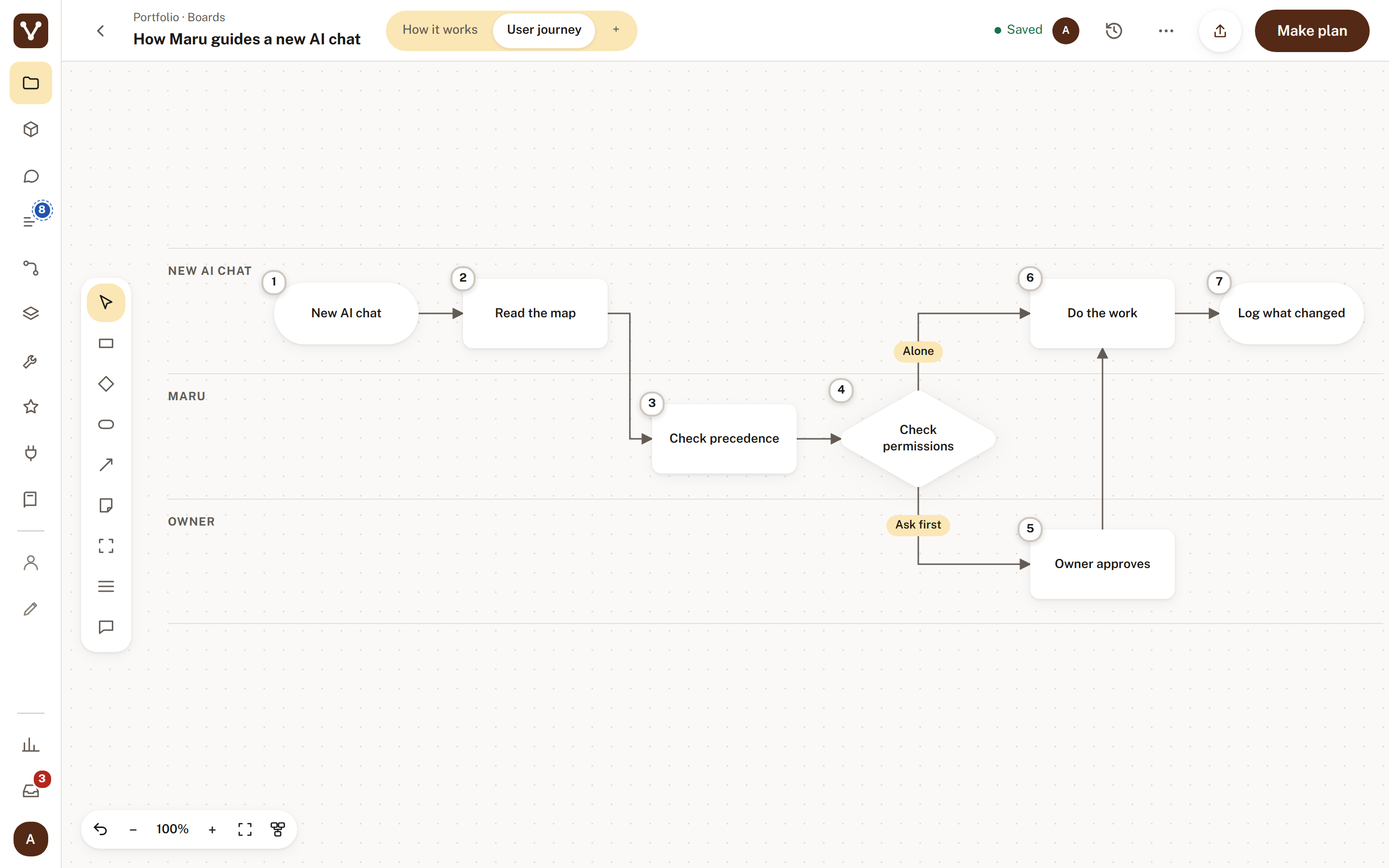
Maru as a board in Vizi: a new AI chat reads the map, checks which rule wins, then acts alone or asks the owner first.
I like getting a usable version in front of people early. A request usually sounds like a solution, so I ask what problem it was meant to fix, and then what a person would actually do on the first screen. We work through the journey together, test the parts that are hard, and turn each decision into a prototype or a build handoff.
What that can include
You get a prototype people can click, with every decision already made.
How it runs
Proof
I designed Flomaru's seller dashboard, admin dashboard and seller onboarding this way: every screen drawn with real example content, then handed to the engineer in the tracker as an interactive design.
See Flomaru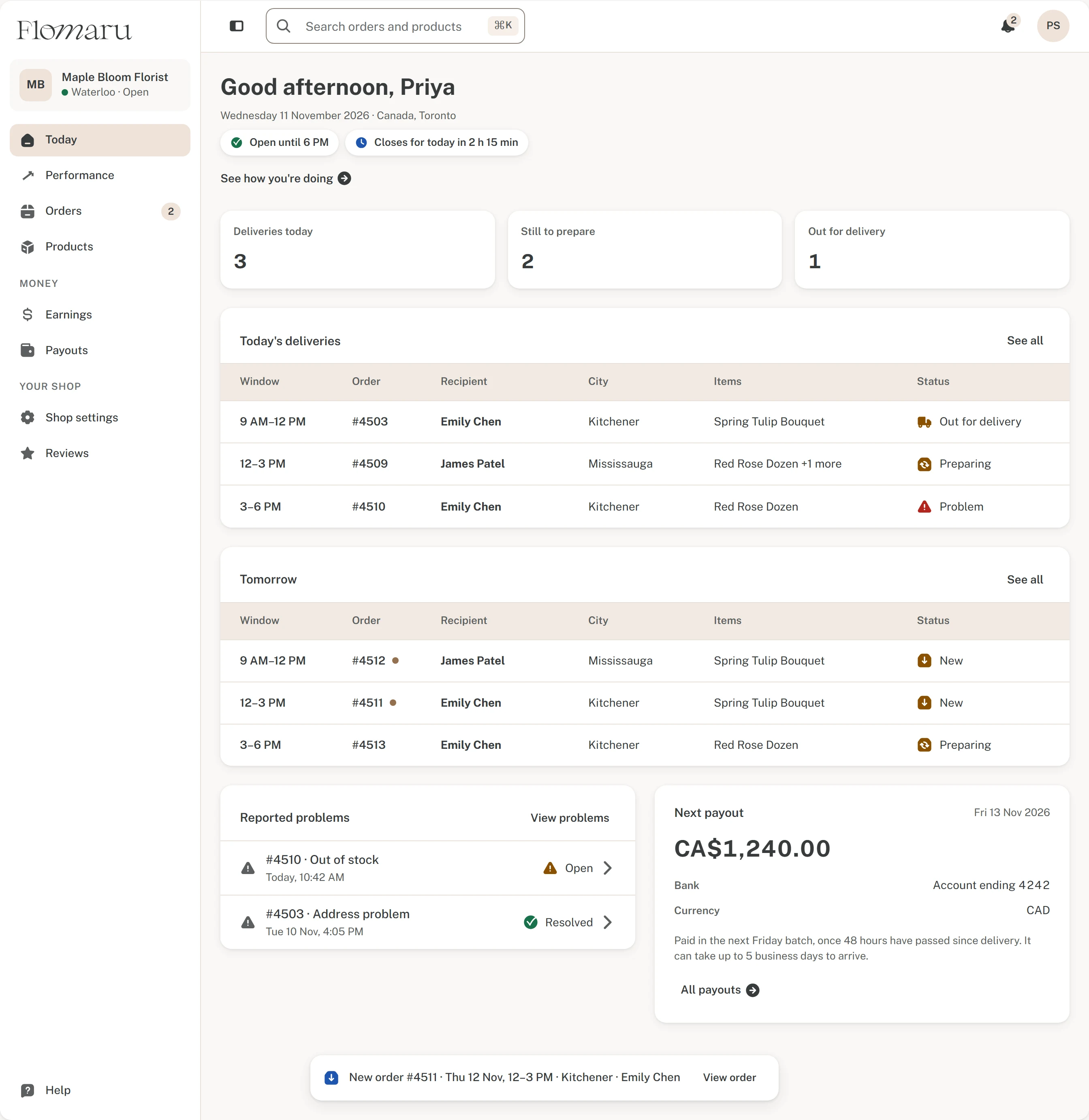
A Flomaru seller dashboard screen as designed, with real example orders: the kind of screen an engineer builds from.
Sometimes the answer is a build. Sometimes it isn't. When the data told me two different stories about the same customer, I stopped asking what to build and started asking who is actually buying. I'd rather find that out first, keep what the evidence shows apart from what everyone assumes, and tell you to wait than watch you build the wrong thing.
What that can include
You get a written answer you can act on, with every claim labelled.
How it runs
Proof
At Flomaru, sign-ups and cheap ad reach were mostly men in the Gulf. The people who actually bought were mostly women in Canada. Pooled together, the data described a customer who didn't exist.
See how I worked out who Flomaru's customer isI work through how people find the offer, understand it and get started. At Flomaru I asked what a seller sees the moment they apply, and what happens when one document is missing. That became a seller journey, and it can just as well be a partner program, a campaign experiment or a better way to follow up.
What that can include
You get a path people can follow, and numbers you can trust.
How it runs
Proof
I designed Flomaru's seller onboarding, including the screen where the team reviews each application, and wrote the rules its growth experiments run by.
See Flomaru seller onboarding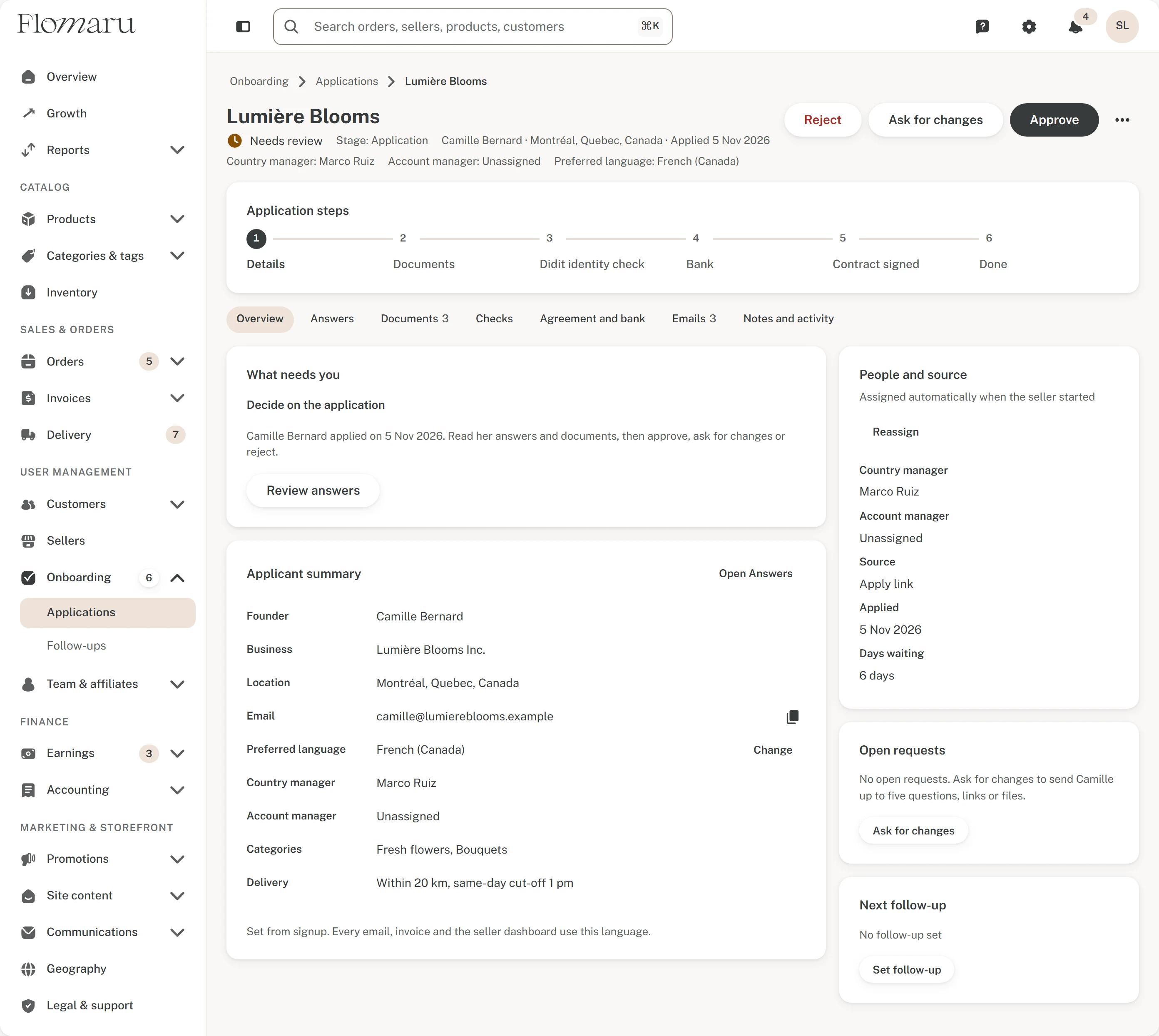
Flomaru seller onboarding, as designed: "Ask for changes" requests a missing document, so a rejection isn't a dead end.
Most teams get one good answer from AI and one bad one, then stop trusting it. I had the same thing, and I don't think the fix is a better prompt. It's a way of working: small steps, a clear idea of what done means before the AI starts, and something other than the AI checking the result. Maybe that is the part worth teaching, on one real job of yours rather than with slides.
What that can include
Proof
I already package my own skills as single files another person's AI can use, and I wrote a guided setup that walks a new user through six steps.
See how I package a system for someone elseRisk in something that already runs is usually a feeling, not a list. I wanted my own company's code to stop being a worry, so every problem got written down on its own, ranked, and handed to the engineers in order. When two numbers disagree, I want to know which one is wrong. Maybe that is all an audit needs to be: a list people can start on.
What that can include
You get a ranked list your engineers can work through from the top.
How it runs
Proof
I ran this on my own company's code and infrastructure, and it became a ranked repair plan for our engineers.
See how I audit a codebase with AI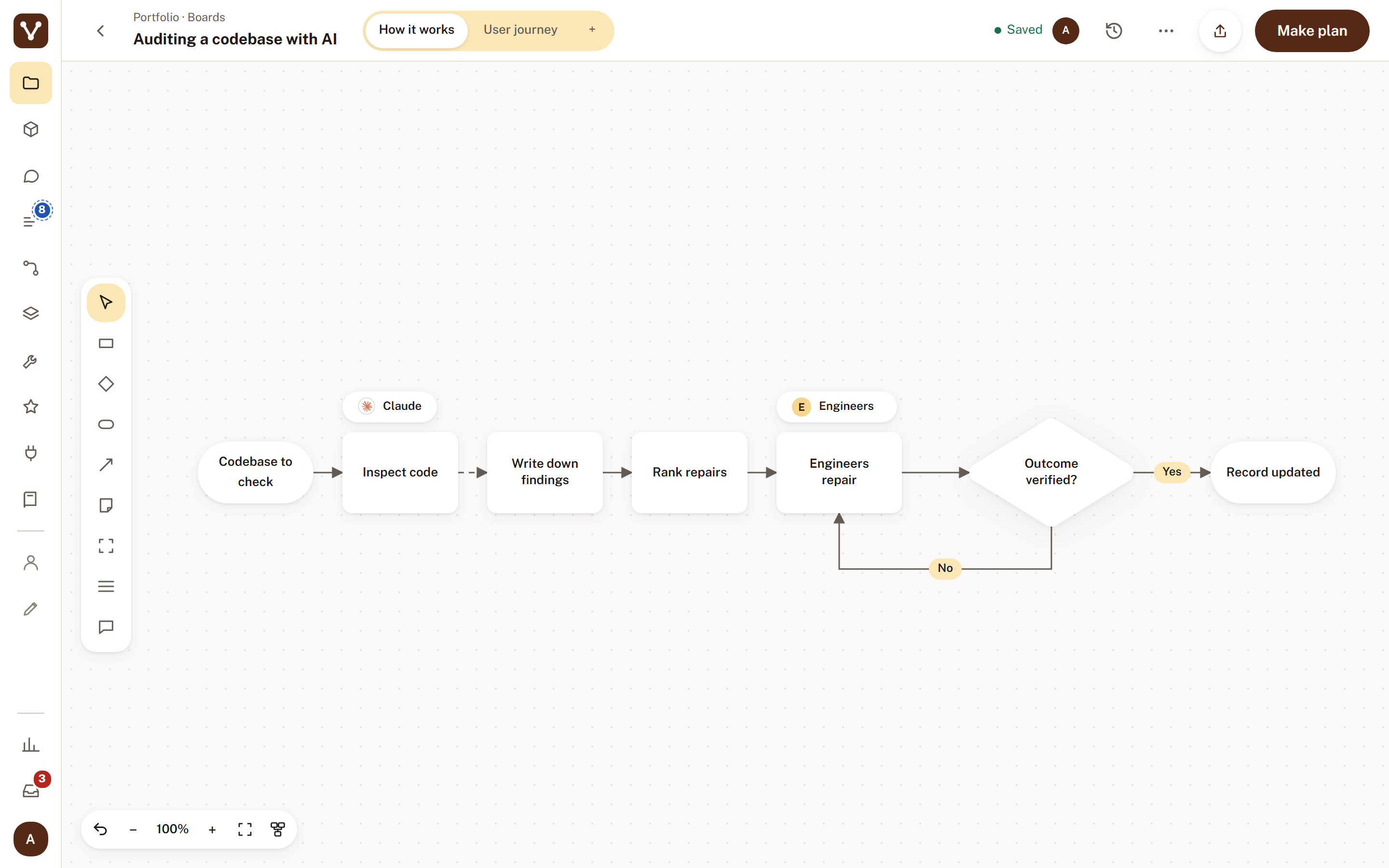
Auditing a codebase with AI, as a board in Vizi.
A good design can still fail at the handover, when the engineer builds something close and then has to ask what you meant. So I make the handover answer those questions before they're asked. That means every screen drawn, every decision written down, and every button given somewhere to go.
What that can include
You get a design an engineer can build from without a meeting.
How it runs
Proof
I've run this process three times: on Vizi, on Flomaru's dashboards and on seller onboarding. On Vizi it ended in a full redesign handed to my technical co-founder.
See how I redesign a product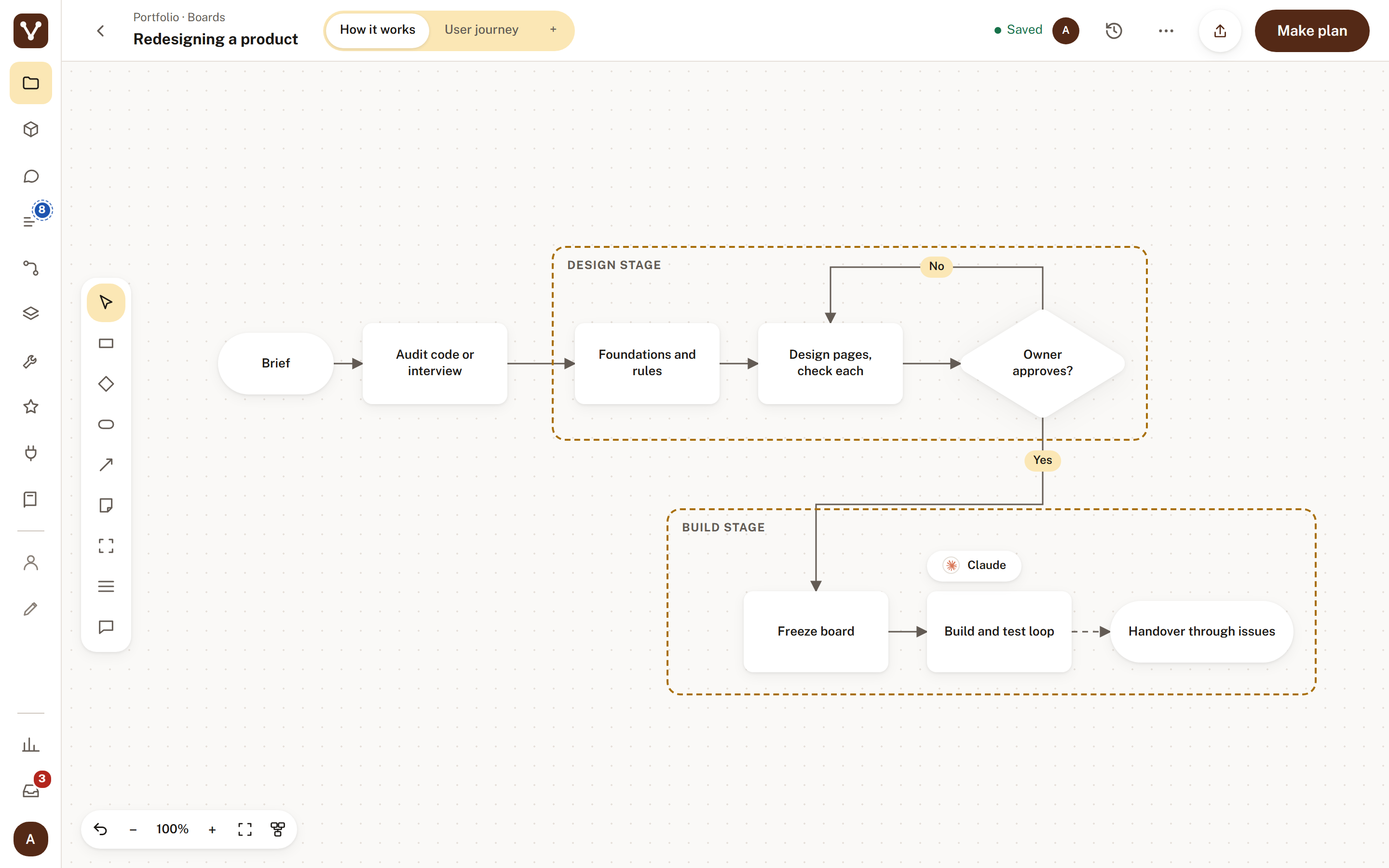
Redesigning a product, as a board in Vizi.
You tell me where the work gets stuck. I ask how it really runs today, not how it's meant to, and who does each step.
Someone who does the work every day, a few real examples of it going wrong, and a look at whatever exists now: a document, a screen, a spreadsheet, the code.
A short written note: the problem as I understand it, what I'd check first, and whether I think this needs a build at all. If I've misread it, you'll see that before anything is built.